Reject Thermal Deformation in Vertical Machining Centers
Release time: 2026-02-05
In the fiercely competitive world of modern precision manufacturing, achieving stringent tolerance standards is only half the battle; maintaining that precision throughout long, high-intensity production shifts is the real challenge. For advanced machining workshops that rely on vertical machining centers to produce high-value-added parts such as aerospace structural components or complex medical devices, heat is the ultimate “invisible killer” of precision. You might have a perfectly calibrated vertical machining center in the morning, with every dimension accurate.
However, as machining progresses, when your vertical machining center continues to run at maximum speed, the internal temperature begins to rise, inevitably triggering microscopic but highly destructive thermal expansion of the material. If your vertical machining center inexplicably develops dimensional deviations mid-operation, forcing skilled operators to frequently stop the machine and manually adjust the offset to “catch up” with the slipping tolerances, then thermal deformation is undoubtedly the culprit.
Understanding how this thermal expansion silently compromises the precision of Vertical Machining Centers, and more importantly, mastering how to prevent it through advanced engineering design, is key to distinguishing a highly profitable, fully automated production line from an inefficient workshop plagued by high scrap rates.
The Physics of Thermal Deformation in Vertical Machining Centers during Metal Milling
In the demanding environment of metal milling, temperature fluctuations are unavoidable. When Vertical Machining Centers operate at high speeds for extended periods, their internal components generate significant kinetic energy, which inevitably converts into heat. This accumulated heat can severely compromise the geometric precision of the entire CNC Vertical Machining Center.
- The Spindle Heating Mechanism of Vertical Machining Centers
The spindle is the heart of any Vertical Machining Center. Operating at speeds of 8,000 to 12,000 RPM or higher, the spindle bearings inside Vertical Machining Centers experience extreme friction. When the spindle housing absorbs this heat, the metal expands. Because the spindle of a Vertical Machining Center is vertical, this expansion primarily forces the tool downwards, altering your precise Z-axis offset without triggering any system alarms.
- Frictional Heat Generation from Linear Guides and Ball Screws
Besides the spindle, the X, Y, and Z-axis motion of a Vertical Machining Center heavily relies on ball screws and linear guides. Sustained high-speed feeds in complex toolpaths generate localized hotspots. Even with top-of-the-line components like THK or HIWIN in your Vertical Machining Centers, the physical law of thermal expansion and contraction dictates that for every 1°C increase in temperature, a 1-meter-long steel ball screw will elongate by approximately 10 to 12 micrometers.
How Thermal Displacement Affects Your Vertical Machining Center
Ignoring thermal expansion turns a high-precision Vertical Machining Center into an unpredictable burden. For workshops machining aerospace components or precision molds, this unpredictability in Vertical Machining Centers can directly impact the bottom line of business profits.
- Z-Axis Elongation and Dimensional Deviations
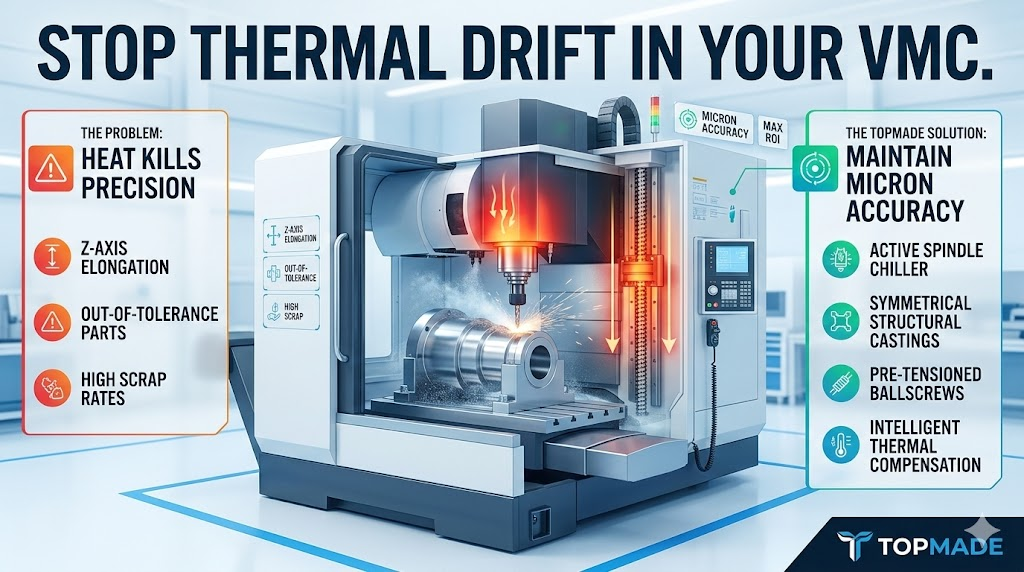
In a vertical machining center, the most direct consequence of heat is Z-axis elongation. When machining deep cavities or performing tight tolerance control on mating surfaces, if the spindle “elongates” by 30 micrometers over a four-hour shift, it will lead to cutting deviations. An operator might perfectly calibrate the vertical machining center in the morning, only to find that the entire batch produced in the afternoon is scrapped.
- The Nightmare of Soaring Scrap Rates in Precision Machining
Unstable tolerances mean higher scrap rates. When state-of-the-art vertical machining centers suffer from uncontrolled thermal deformation, machinists are forced to constantly pause production and manually input offsets for compensation. This frequent manual intervention defeats the purpose of investing in automated vertical machining centers, significantly reducing spindle utilization and overall return on investment (ROI).
Engineering Solutions for Maintaining Vertical Machining Center Accuracy
To address these physical challenges, modern vertical machining centers must be designed from the outset to mitigate, absorb, and compensate for heat generation. Purchasing a Vertical Machining Center with a superior thermal management architecture is crucial for long-term success.
- Advanced Spindle Cooling System: High-end Vertical Machining Centers employ an active oil cooling system that circulates directly within the spindle cooling jacket. Unlike ambient air cooling, the active oil cooler maintains the spindle unit of the Vertical Machining Center at a constant temperature, precisely matched to the workshop ambient temperature. This significantly reduces the downward thermal expansion of the tool in high-performance Vertical Machining Centers.
- Symmetrical Casting Design: The cast iron frame of the Vertical Machining Center plays a vital role in thermal stability. Advanced Vertical Machining Centers feature a symmetrical column and base design. When heat is generated, the symmetrical Vertical Machining Center expands evenly, ensuring perfect alignment of the spindle centerline with the worktable. This structural balance prevents the twisting or bending common in inexpensive, asymmetrical Vertical Machining Centers.
- Pre-tensioned Ball Screw and High-End Components: To counteract elongation caused by axial friction, high-quality Vertical Machining Centers are equipped with pre-tensioned ball screws. By moderately stretching the lead screw and firmly securing both ends during assembly, the Vertical Machining Center internally absorbs initial thermal expansion without affecting pitch accuracy. Combined with high-grade PMI or HIWIN guideways, this ensures that Vertical Machining Centers maintain micron-level repeatability.
TopMade’s Solution for Stable Vertical Machining Centers
At TopMade, we understand that the quality of a Vertical Machining Center depends on its thermal stability. When designing CNC Vertical Machining Centers, we ensure they can handle heavy-duty, continuous metal cutting without sacrificing accuracy.
- Intelligent Thermal Compensation Technology
Every TopMade Vertical Machining Center can be equipped with an advanced CNC system with intelligent thermal compensation. Sensors placed in critical heat-generating areas feed real-time temperature data back to the controller, which automatically adjusts the tool position during machining, ensuring perfect cutting from the first part to the last.
- Rigorous 72-Hour Dynamic Testing
Before any Vertical Machining Center leaves our factory, it undergoes a rigorous 72-hour continuous dynamic operation test. We measure the thermal displacement of the Vertical Machining Center under maximum load conditions to ensure flawless performance of the cooling system, delivering a Vertical Machining Center you can rely on in any high-precision application.